

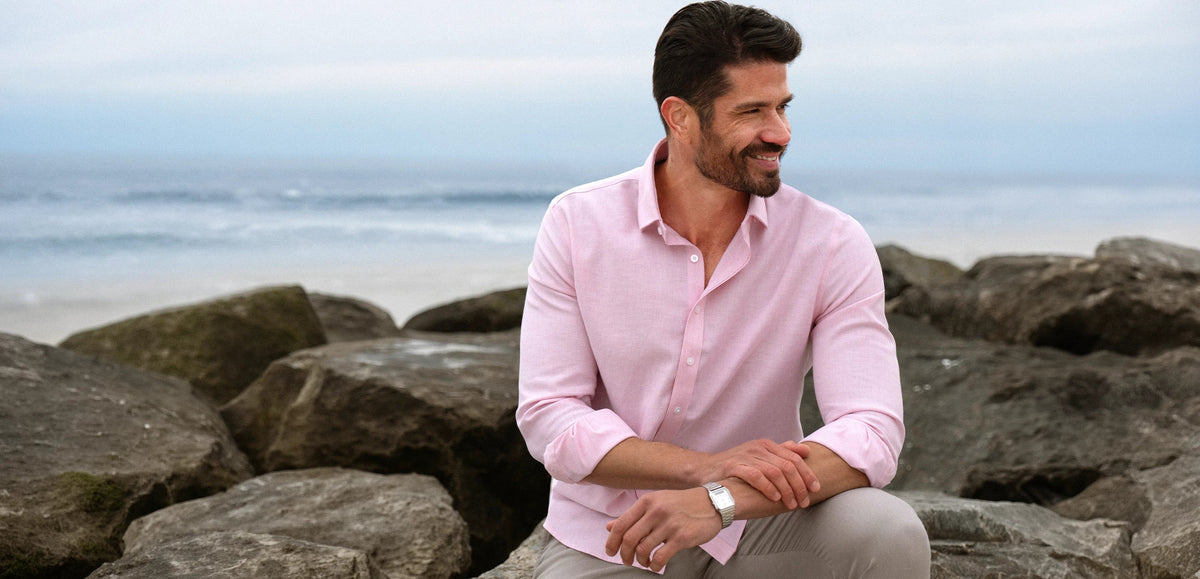
1. How should men wear a white linen shirt?
A white linen shirt works untucked with chinos and loafers for smart-casual, tucked into tailored trousers with a navy sport coat for business-casual, or unbuttoned over a tee for full-casual. It pairs with almost any pant color.
The simplest rule is to let white carry the outfit. Pair it with quieter colors below the waist — light beige, sand, olive, navy, and stone-gray chinos all read clean. Avoid pairing white linen with white pants unless you're committing fully to a coastal look (loafers, sunglasses, location).
Shoes
- Leather loafers and white sneakers are the strongest defaults.
- Brown suede loafers add warmth in summer; white leather sneakers keep the look modern.
- Skip black dress shoes — too formal for the fabric.
Tucking
- Tuck only when you have a defined waistline (a belt, dress chinos, or trousers with a waistband).
- With shorts or drawstring chinos, leave it untucked.
Layering
- A navy or olive linen sport coat is a flattering layer.
- A denim jacket works for casual settings.
- Avoid heavy-wool suit jackets — the fabric mismatch is jarring.
Collars and sleeves
- Open collar with one or two buttons undone is the default in warm weather.
- Completely unbuttoned over a tee is a perfect weekend casual look.
- Buttoned to the top only with a sport coat — without one it looks unfinished.
- Sleeves rolled twice to the mid-forearm is the most flattering option for most men.
The Twillory Performance Linen Shirt is cut at an untucked length, so it sits clean over chinos and shorts without bunching at the waist. If you want one shirt that handles dinner, weekend brunch, and a beach wedding from the same hanger, white is the color that gets you there with the fewest compromises.
2. Performance linen vs. 100% linen vs. cotton: which is best for summer?
Performance linen blends sit between pure linen and pure cotton on every summer metric. They're more breathable than cotton but less than 100% linen, less wrinkle-prone than linen but more than wrinkle-free cotton, and easier to maintain than either.
100% linen
The gold standard for natural breathability. Air moves through the open weave, sweat evaporates quickly, and the fabric hangs away from the skin. It's also the most prone to deep wrinkles, the most likely to look slept-in by lunchtime, and usually requires careful machine cycles to avoid fading or breaking down too fast. Best for vacation, beach, and hot casual settings where wrinkles read as authentic.
100% cotton (oxford, poplin, twill)
The most durable, versatile option. It machine-washes without complaint, holds shape, and handles ironing well. It's also the warmest of the three in heat and the heaviest. Best for office shirts year-round where the shirt needs to look crisp at 5 PM as well as 9 AM.
Performance linen blends
Typically 50–85% cotton, 10–30% linen, 0–5% spandex. They behave like cotton in the wash, look like linen in the mirror, and breathe better than pure cotton without the high-maintenance wrinkle behavior of pure linen. Twillory's Performance Linen at 82/13/5 leans cotton-majority, keeping it opaque, soft, and machine-friendly while picking up enough linen texture to read summer-appropriate.
Heat ranking (hottest to coolest on the body)
- 100% cotton oxford — warmest
- Performance linen blend (cotton-majority) — moderate
- 100% linen — coolest
Wrinkle ranking (most to least)
- 100% linen — most
- Performance linen blend — moderate
- 100% cotton (poplin or twill) — least
For most men, the practical answer is: own one performance linen shirt for everyday summer wear, one 100% linen shirt for vacation or true heat, and skip the cotton oxfords until October.
3. Can men wear a linen shirt to a summer wedding?
Yes, men can wear a linen shirt to most summer weddings, especially outdoor, beach, garden, or daytime ceremonies. White, light blue, and khaki are the safest colors. Avoid linen at black-tie weddings or formal evening ceremonies in winter venues.
The dress code matters more than the fabric. Linen is appropriate for casual, semi-formal, and summer-cocktail codes. It's borderline for formal outdoor weddings (acceptable in lighter colors with a sport coat). It's not appropriate for black-tie, white-tie, or formal indoor evening weddings.
By venue
- Beach or outdoor: linen shirt + linen-blend or cotton trousers + loafers. Untucked or half-tucked is fine.
- Vineyard, barn, or casual outdoor: linen shirt tucked into chinos with a sport coat and brown loafers.
- Indoor daytime: linen shirt under a navy or tan sport coat, tucked, with dress chinos or wool-blend trousers.
- Indoor evening (semi-formal): borderline — if you go this route, white or pale blue, tucked, with a tailored sport coat. A 100% cotton dress shirt is safer.
- Black-tie or formal evening: skip linen.
Color rules
- White — most versatile.
- Light blue — works for any daytime wedding.
- Khaki or sand — beach and garden, not indoor.
- Red, pink, coral — casual outdoor only.
- Green or olive — casual outdoor only.
For grooms or wedding parties, a performance linen shirt is often a smart pick: it photographs like 100% linen but survives the rehearsal dinner, ceremony, and reception without re-pressing.
4. Tucked or untucked: when should you wear a linen shirt each way?
Tuck a linen shirt when the setting is dressier than the fabric — business-casual, indoor weddings, dinner with a sport coat. Wear it untucked when the setting matches or is below the fabric's formality, which covers most casual summer wear.
Tuck when
- You're wearing a sport coat or blazer — untucked under a jacket looks unfinished.
- Your pants have a defined waistband, belt loops, and a belt: chinos, dress trousers, wool-blend pants.
- You're in a venue at least business-casual: office, restaurant, indoor wedding, business meeting.
Don't tuck when
- You're wearing shorts.
- You're wearing drawstring pants, joggers, or elastic-waist pants.
- You're at the beach, on vacation, or at a casual outdoor setting.
The half-tuck
Tuck only the front, leave the back out. Reads deliberate (not lazy) with relaxed chinos and loafers. Works with most untucked-length shirts. Skip it with formal wear.
Quick length test
With your hand at your side, the hem should fall between the bottom of your zipper and the top of your back pocket. Lower than that = too long for untucked. Higher = too short. The Twillory Performance Linen Shirt is built to that length.
5. How do you wash, dry, and iron a linen-blend shirt?
Wash a linen-blend shirt in cold water on a normal cycle, tumble dry on medium, and remove it slightly damp. Warm iron handles any remaining wrinkles. Don't bleach, don't wash too hot, and don't over-dry — those are what actually damage the fabric.
Washing
- Cold water, normal or delicate cycle.
- Wash whites with whites — yellowing risk increases over time with color bleed.
- Skip fabric softener — it coats linen fibers and reduces breathability.
- Don't bleach. Even chlorine-free bleach weakens linen fibers.
Drying
- Tumble dry on medium heat. Remove while slightly damp.
- Hang or lay flat to finish drying.
- Avoid high heat — it sets wrinkles and shrinks linen content even in a blend.
Ironing
- Use a warm setting (linen heat or one level below).
- Iron while the shirt is still slightly damp for the cleanest finish.
- Iron the inside of the collar and cuffs first, then the sleeves, then the body.
Travel
- Roll, don't fold — rolling avoids sharp crease lines.
- Hang in the bathroom while you shower. Steam releases wrinkles in 5–10 minutes.
Yellowing prevention (white shirts)
- Wash promptly after wearing. Sweat accelerates yellowing.
- Air-dry in shade, not direct sun. Sunlight yellows white linen and white cotton over time.
6. What undershirt should you wear under a white linen shirt?
Wear a light gray, skin-tone, or invisible undershirt under a white linen shirt — never a white one. White-on-white is highly visible because the undershirt's edges show as a darker line through the linen, while gray and skin-tone disappear entirely.
The crew-neck collar and sleeve hems of a white undershirt create higher-contrast shadow lines through thin white linen than any other color. A gray or skin-tone undershirt has lower contrast against visible chest skin, so the eye doesn't pick up the seams.
Best undershirt fabrics under linen
- Modal or micro-modal — extremely thin, fast-drying, no bulk.
- Bamboo blends — breathable, soft, non-clingy.
- Cotton mesh — premium option.
Undershirts to avoid
- Heavy cotton crew-necks — too thick under a thin linen.
- Compression shirts — too clingy and trap heat.
The undershirt test
Stand in your bathroom with the door open and the light at your back. If you can see the undershirt's seam outline through the linen, swap it.
Many men wear linen shirts directly against the skin in summer — linen is breathable enough to manage sweat alone. The Twillory Performance Linen Shirt is opaque enough that an undershirt is not strictly required for the white version.
7. How do you keep a linen shirt from looking wrinkled all day?
Three habits keep a linen shirt looking sharp all day: hang it overnight (don't fold), iron or steam it before wearing, and shift posture every hour or so. Linen's crease memory is what creates the mid-day rumpled look.
Pre-wear
- Hang on a wide-shouldered hanger overnight, not on a hook or chair back.
- Steam for 30 seconds with a handheld steamer, or warm-iron lightly. Mist a fine spray of water on stubborn folds before steaming.
- Skip starch — it sets creases more aggressively and makes linen feel stiff.
During wear
- Don't carry a heavy laptop or duffle bag strap across the shirt for hours — it presses creases that don't release.
- Stand and stretch every 45–60 minutes if you're sitting for a long meeting or meal.
- Avoid leaning hard against high-back chairs — shoulder blades crease the back of the shirt.
Mid-day rescue
- Carry a compact spray bottle for travel — a fine water mist plus 2–3 minutes hanging free is usually enough.
Linen, even blended, isn't a poly-stretch shirt. Some softness and lived-in texture is the intended look. Aim for 'relaxed but intentional,' not 'starched and crisp.'
8. Can you wear a linen shirt to the office? A business-casual guide.
Yes, a linen shirt works at most business-casual offices in summer. Tuck it in, pair with chinos or wool-blend trousers, and add a sport coat for client-facing days. Avoid linen for offices that require ties or full suits daily.
Office tiers and where linen fits
- Tech / startup / creative casual: linen shirt untucked with chinos. White, light blue, or khaki.
- Business casual: tuck in. Linen with chinos and loafers; sport coat optional. White or light blue.
- Smart business: linen acceptable in summer with a sport coat. White or light blue only, tucked in.
- Business formal / suit-and-tie: skip linen. Stick to cotton dress shirts.
Pant pairings
- Wool-blend trousers (charcoal, navy, tan) — most polished.
- Chinos (stone, navy, olive) — solid default.
- Denim — only in true creative-casual environments.
The sit test
Sit at your desk for 20 minutes wearing the shirt. If it wrinkles into deep folds across the lap and chest in that time, it's a casual shirt — not an office one. A performance linen blend is more likely to pass this test. Pure linen may wrinkle more quickly.
9. How long does a linen shirt last, and how can you make it last longer?
A well-maintained linen-blend shirt can last multiple seasons of regular summer wear, depending on wash habits, frequency of wear, and storage. The biggest life-shorteners are hot washes, bleach, fabric softener, over-drying, and storing folded for long periods. Pure linen tends to last longer but shows wear differently.
What kills a linen shirt fastest
- Hot water and high-heat drying — linen fibers shrink and weaken; spandex degrades faster on hot cycles.
- Bleach — yellows white over time and weakens fibers across all colors.
- Fabric softener — coats fibers, reduces breathability, traps body oils.
- Folding for long-term storage — fold creases thin the fabric over years.
- Sun-drying — yellows white, fades color, weakens UV-exposed shoulders.
What extends life
- Cold wash, medium dry, hang to finish.
- Wear in rotation — give a shirt 2–3 days between wears for fibers to recover.
- Use cedar or solid-wood hangers, not wire.
- Pre-treat sweat stains immediately.
- Wash promptly after wearing in heat.
How a linen-blend shirt typically wears in
- Early on: crisp hand, tight weave, fully structured collar and cuffs.
- With regular wear and washing: the hand softens, the fabric relaxes slightly, and some crease memory tends to develop at the elbows and collar fold.
- Later in the shirt's life: the cuff fold and collar band are usually the first areas to show wear, and the fabric can begin to thin in those spots.
Repair points
- Cuff fraying: a tailor can often replace the cuffs, usually cheaper than replacing the shirt.
- Collar-fold thinning: a tailor can sometimes turn the collar to extend the shirt's life.
- Button replacement: simple DIY.
10. Why are most 'performance linen' shirts not 100% linen?
Most 'performance linen' shirts are blends because 100% linen wrinkles aggressively, shrinks in hot washes, and feels stiff. Cotton softens the hand, blocks see-through, and makes the shirt machine-washable. Spandex adds stretch. The trade-off is slightly less breathability.
'Performance linen' is a marketing category, not a fabric standard. It means a blend containing some linen with engineering applied to fix linen's worst behaviors — wrinkling, shrinkage, transparency, stiffness. Linen percentage varies widely (10–50%), with the rest typically cotton plus optional spandex or polyester.
Why brands blend instead of selling pure linen
- Wrinkle control: pure linen shows deep creases within an hour of wearing. A blend with 60%+ cotton wrinkles like cotton, not linen.
- Wash durability: pure linen can shrink noticeably on hot washes. A cotton-majority blend tends to behave more like cotton in the wash with less shrinkage.
- Opacity: pure white linen is partially translucent. Cotton fibers fill the weave and block light.
- Stretch: 100% linen has zero stretch. 1–5% spandex adds shoulder and elbow give.
- Cost: pure linen fabric typically costs more than cotton at comparable weights, which is part of why blends are common at accessible price points.
What the buyer trades away
- Authentic drape: 100% linen has an airy, slightly slubby texture no blend perfectly reproduces.
- Maximum breathability: pure linen wicks and dries faster. In 95°F+ direct sun it's measurably cooler.
- Long-term patina: pure linen develops a more characterful softness over decades. Blends soften but plateau.
How to read a label
- 80%+ cotton, 10–20% linen, 1–5% spandex: most 'performance,' lowest maintenance, most even texture.
- 50–70% linen, 30–50% cotton: balanced; reads more linen-authentic with some structural benefit.
- 100% linen: classic; highest maintenance, most authentic, most breathable.
The Twillory Performance Linen Shirt is on the cotton-majority end at 82% cotton, 13% linen, 5% spandex. That's deliberate — it's the lowest-maintenance, most office-friendly version of the category. If you want the real linen experience, buy 100% linen and accept the wrinkles. If you want a shirt that looks summer-appropriate and survives a 9-to-5, a wedding, and a beach trip without becoming a wreck, the blend is the answer.
